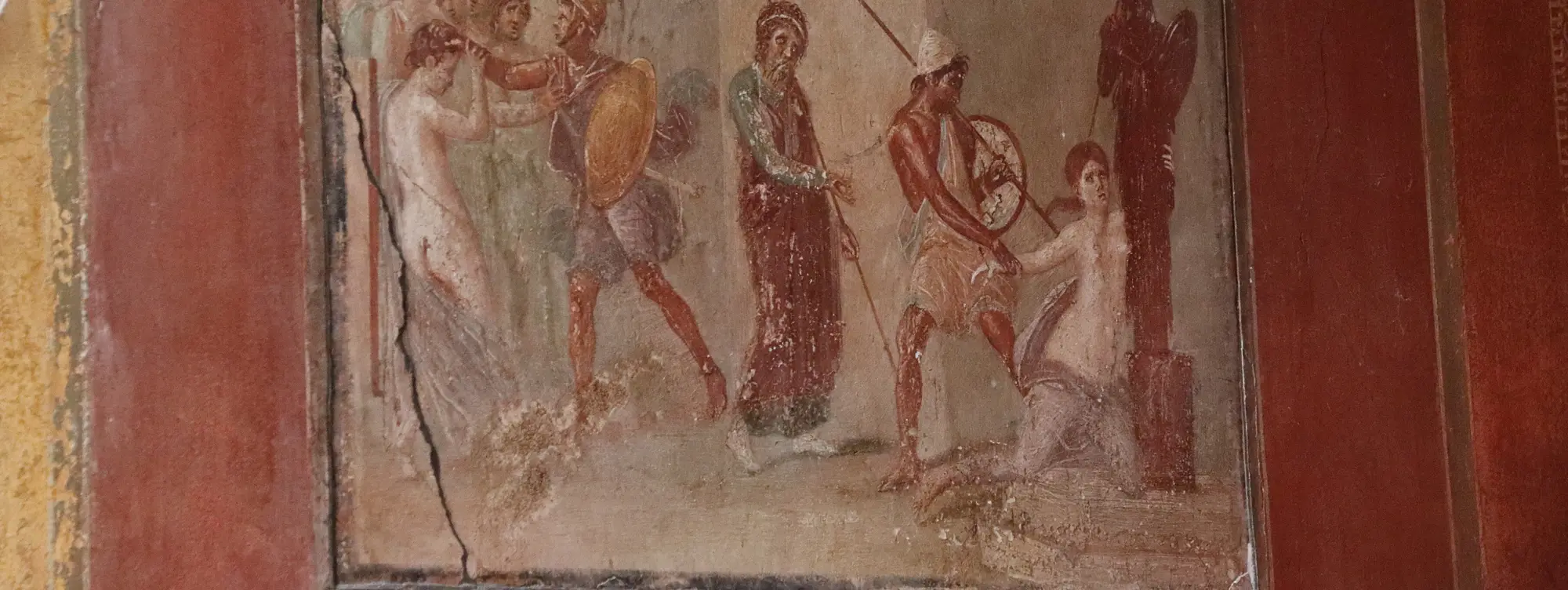
How the poem has been edited, explained and argued over, from the ancient commentators to the present. Every claim below is attributed to the scholar who made it and to the page where the Library read it; the per-line "Scholarship" panel in the reader draws on the same chronology.
1. Antiquity: a poem that needed a commentary from the start
The Alexandra was obscure on purpose, and it was read with help almost as soon as it existed. The Suda already calls it τὸ σκοτεινὸν ποίημα, "the dark poem", and Statius speaks of "the lurking-places of black Lycophron" (latebrasque Lycophronis atri, Silvae 5.3.157). Several grammarians wrote commentaries on it; the most important was Theon, the Augustan scholar of Alexandria, and the surviving scholia vetera are held to derive largely from him. The oldest layer of these scholia already does what this website does: it names the heroes behind the periphrases, supplies the mythological background, cites lost authors and records variant readings. It also contains the first doubt about the poem's authorship. At line 1226, where Cassandra begins to foretell Roman power, the scholiast remarks that from here on the poet speaks of the Romans, and that the poem must therefore be by "another Lycophron" — a friend of Ptolemy Philadelphus would not have talked like that about Rome. Every later argument about the date descends from that note.
Fragments of the poem on papyrus (P.Oxy. 2094, P.Monac. 156, PSI 724, and perhaps P.Oxy. 2463) show that it was being copied, and commented on, in Egypt in the first three centuries AD.
Mooney 1921, p. xii (Theon; Tzetzes); Mair 1921, pp. 480, 482 (Suda; schol. 1226 quoted); Jones 2014, p. 41 n. 2; West 1983, p. 114 n. 1 (the papyri, with Criscuolo 1970). On Theon as the source of the old scholia the fundamental discussion is Scheer's 1881 praefatio and 1908 prolegomena; the Library has read the prolegomena on the scan (pp. V–VI on the editions and on the Tzetzes question), while Scheer's Theon argument in the 1881 praefatio is still cited at second hand.
2. Byzantium: the Marcianus, the paraphrases and the Tzetzes brothers
The whole later tradition rests on one book: Venice, Marciana gr. 476, written in the eleventh century by a deacon named Nicetas, whom Scheer identified with the metropolitan of Serrhai. It carries Aratus and then the Alexandra with the old scholia and two prose paraphrases, an older (P) and a younger (p). A tenth-century lexicon manuscript, Coislin 345, preserves the poem only as lemmata chopped into phrases, each followed by paraphrase P — so corrupt, Scheer wrote, that he had seen no Lycophron manuscript except Par. 2840 equally bad. The scholia and paraphrases were the ordinary reader's way into the poem for a thousand years, and the Library's reader restores them to that place beside the text.
In the twelfth century Isaac Tzetzes, with his brother John, produced the enormous commentary that travels with the poem in most of the hundred-odd later manuscripts (see the manuscripts page). It is a work of real learning and real carelessness: Momigliano noticed that Tzetzes "arbitrarily" moved the name of Timaeus from the old scholium on 1155 to his own note on 1141, a transfer Wilamowitz had already exposed. Tzetzes is also the first to defend the poem's unity: he dismisses the old scholiast's "other Lycophron" as ridiculous. André Hurst has argued that the poem's prophetic voice drew it, by the time of Eustathius of Thessalonica, toward the Christian canon of prophets; and that a text which packages a closed body of knowledge in riddles necessarily generates two kinds of secondary text, the paraphrase that says it plainly and the commentary that unfolds what it knows.
Scheer 1881, praefatio pp. vii–viii (A, B; Nicetas, with RhM 34, 281); Mair 1921, pp. 488–489 (English summary of Scheer's MSS classes); Mooney 1921, pp. xii, xix; Momigliano 1945, p. 49; Hurst 2010 (CCGG 21, 409–417). The Tzetzes commentary is edited by Müller (Leipzig 1811) and Scheer (vol. II, Berlin 1908); the old scholia by Kinkel (1880), Scheer (1908) and Leone (2002).
3. Printed editions, 1513–1702
The editio princeps is the Aldine of 1513. It was followed by Lacisius (Basel 1546, 1547; a Paris reprint of 1547), by Willem Canter's Basel edition of 1566 — the first with a word-for-word Latin version, soon joined by Joseph Scaliger's iambic Latin Cassandra — by Meursius at Leiden (1597, 1599), and by John Potter's Oxford edition of 1697, enlarged in 1702, with Tzetzes, the Latin versions, variant readings, indices and a Testimonium Veterum on the poet's life. Canter's readings and explanations are still cited by Mooney in 1921 (Χοιράδος restored at 403; ῥοιζουμένῳ at 66). Potter remained the standard text for most of the eighteenth century, and Scheer was still collating manuscripts against Potter's second edition when he prepared the scholia. Isaac Casaubon's unpublished notes on Lycophron have been studied by Hurst (1983).
Mooney 1921, p. xix ("Principal editions of the Alexandra") and notes on 66, 403; Scheer 1881, apparatus on 268 (editors after Meursius); Mair 1921, p. 482 (Potter's Testimonium); Hurst 1983 (BHR 45) — catalogue record only. The Scaliger–Canter 1590 issue is in the Library's catalogue harvest; the claim that Milton owned Potter's edition, carried in an earlier draft of this page, could not be verified and has been removed.
4. The "Lycophron question" is born, c. 1800–1830
The modern debate began not in a university but in correspondence. Charles James Fox, reading the poem with Gilbert Wakefield, observed that a Greek poet before the First Punic War could not have described Roman power in the terms of 1226 ff. and 1446 ff.; Richard Payne Knight wrote to Samuel Parr that the two of them had been "startled with the distinctness of some predictions of events which happened long after the age when he is supposed to have flourished", and wondered, half seriously, whether Lycophron had been a Jew or an atheist who had talked to prophets. Fox's own solution was that the two Roman episodes, 1226–1280 and 1446–1450, were late interpolations in an otherwise genuine poem — the first statement of the "interpolation" position. In Germany, Niebuhr (1827) took the other road: the poem is a unity, but it was written after the Antiochene war (after 188 BC) in honour of Flamininus, by an otherwise unknown younger Lycophron of Chalcis. Welcker accepted Niebuhr's proof that the Roman passages could not have been written at Philadelphus' Alexandria, read 1446–1450 of Flamininus as he did, but kept the tragedian as author of everything else. Holzinger, surveying the field in 1895, found that almost everyone since had sided with Niebuhr or with Welcker, or wavered between them; the older view of a unified poem written under Philadelphus, last defended by the editor Reichard (1788), seemed abandoned. Clinton tried a middle date, after Duilius' naval victory of 260, which he saw in line 1229.
Mair 1921, pp. 482–483 (Fox; Knight to Parr, Parr's Works vii, 304; Niebuhr, RhM 1, 1827, 108 ff.); Holzinger 1895, pp. 52–53 (Fox's interpolation view; Niebuhr; Welcker; Reichard; Clinton; Osiander); Mooney 1921, p. xi (Clinton, Fasti Hellenici III). Schade 2011 (Notes & Queries 58) revisits the English readers of this period — not yet read.
5. The nineteenth-century editors
Reichard (Leipzig 1788) and Sebastiani (Rome 1803) were followed by C. G. Müller's three volumes (Leipzig 1811), which completed Reichard's plan by printing the Tzetzes commentary with the notae variorum and previously unpublished scholia minora. Ludwig Bachmann's edition (Leipzig 1830) added the paraphrase from Vat. gr. 1307 and a Varietas lectionum; Gottfried Hermann's long review of it began the serious study of Lycophron's trimeter, and Bachmann's remarks and index underlie Joseph Konze's De dictione Lycophronis (1870), the first systematic account of the poem's diction and dialect forms. Dehèque's Greek-and-French edition (Paris 1853) gave French readers the poem; Mooney found it "of little service". Viscount Royston's English verse (Cambridge 1806) was the only English version before 1921 — "very florid and diffuse", Mooney says, and some 250 lines longer than the Greek.
The decisive work was Eduard Scheer's. His articles in Rheinisches Museum 34 (1879) on the transmission of the Alexandra sorted the manuscripts into classes and identified the scribe of the Marcianus; the text followed in 1881 (Berlin, Weidmann), with the two paraphrases, a praefatio on the manuscripts, and an Index vocabulorum that classifies every word as unique to Lycophron, first used by him, borrowed from old poets, or shared with other Alexandrians — Holzinger counts 328 hapax legomena in it. Scheer himself remarked, in 1879, that the student of this poem enjoyed a pleasure no other Greek poet offered: he worked almost entirely without modern literature. Gottfried Kinkel's Teubner of 1880 printed the text with the old scholia. Scheer's second volume, the scholia and Tzetzes with prolegomena on their sources, did not appear until 1908; reprinted in 1958, it remains the standard edition of the commentaries, supplemented for the old scholia and paraphrases by Leone (2002).
In 1883 Wilamowitz's Greifswald lecture-programme De Lycophronis Alexandra commentatiuncula reopened the question of date from the other side. He defended the unity and authenticity of the poem, placed its composition at Chalcis before Philadelphus' accession (Susemihl and Mooney give c. 295), read lines 1435–1445 of Alexander the Great with the "Argives" as Persians, and — counting the "six generations" of 1446 upward from Cassandra to Zeus — identified Cassandra's kinsman as the Persian Artabazus, father of Barsine. Holzinger thought Wilamowitz had answered his predecessors so well that the details need not be rehearsed, and that his own constructions were unlucky. Carl von Holzinger's own edition (Leipzig 1895), Greek with a German verse translation and the fullest explanatory commentary the poem had ever had, took the poem to be a unity by the tragedian written about 274 BC: the lion of 1439 is Pyrrhus, the wolf of Galadra Demetrius Poliorcetes, the "one wrestler" Fabricius, and the six γένναι six harvests of the Pyrrhic war — a reading Mair calls "most improbable". Emanuele Ciaceri's Italian translation and commentary (Catania 1901) put the poem earlier still, about 302. For a hundred years, as Fabian Horn has observed, Holzinger's was the last full commentary.
Mooney 1921, pp. vi–vii, xi–xii, xix; Holzinger 1895, pp. 1–3 (Hermann, Scheer, Konze, Bachmann, Susemihl) and 52–54 (Wilamowitz); Mair 1921, pp. 481, 483–484, 488; Scheer 1881, praefatio; Scheer 1879 (RhM 34, 272–291, 442–473) — catalogue record; West 1983, p. 114 n. 1 (editions still cited); Horn 2017 (Gnomon 89, 689).
6. 1921: Mooney and Mair
Two English editions appeared in the same year. George Mooney of Trinity College Dublin (London, Bell) gave a plain prose translation — "a translation which itself requires a translation is of little practical use" — with notes confined to identifying the references, leaning heavily, as he says, on Holzinger and Ciaceri, and with an introduction on the poet's life, the date, the manuscripts and the editions. A. W. Mair's Loeb (with Callimachus and Aratus) printed Scheer's text with a facing prose version and a long introduction that still gives the clearest English account of the dating controversy from Fox and Niebuhr to Corssen. Mair's view of the date is in effect Corssen's (RhM 68, 1913): the poem is a unity by the tragedian; its subject is the balancing justice of fate between Asia and Europe; the six generations are Macedonian kings from Alexander to Pyrrhus; the "wrestler" is the Roman people; and the occasion is the Roman embassy of 273 BC to Alexandria, so that Cassandra's prophecies never outrun the poet's own time. Barber reviewed Mooney in the Classical Review of 1922. Both books are public domain: Mair's is the Library's base text and default translation (decisions D2, D4), and Mooney's notes are its first layer of commentary. Until 2015 they were the only English Lycophron.
Mooney 1921, pp. v–vii (preface), ix–xii; Mair 1921, pp. 480–490 (introduction; Corssen reported at 484–488); Sens 2024 (JHS 144, 309–310) on the English reader's options before Hornblower.
7. The date: a century of argument
Since Fox there have been three positions, which Stephanie West's 1984 survey labelled and which Hollis and Jones restate: (a) the whole poem is by Lycophron of Chalcis, the tragedian of the Pleiad and comedy-scholar of the Alexandrian Library, early third century; (b) the whole poem is second-century, by "another Lycophron" or an author whose name is lost; (c) the poem is third-century but the Roman passages, 1226–1280 and 1446–1450, were added later. Konrat Ziegler's great Realencyclopädie article (1927) and Beloch argued for (b); Bates (1895), Corssen (1913), Mair, Holzinger and Ciaceri for (a). Momigliano entered the argument twice for the early date: "Terra marique" (JRS 1942) read the "sceptre of land and sea" of 1229 against Roman–Ptolemaic contacts of the 270s, drawing replies from Walbank; and "The Locrian Maidens and the date of Lycophron's Alexandra" (CQ 1945) argued from the poem's own description of the Locrian tribute (1141–1173) as lifelong and non-annual — a form of the custom untouched by its revival under Antigonus Gonatas — that the poem is earlier than the First Punic War, an argument he presented as independent of politics and literature, while admitting it would not move "very firm believers in the second-century date".
The balance tipped the other way in the twenty-first century. Elisabeth Kosmetatou (2000) attached the poem to the Pergamene court and Attalid patronage in the first half of the second century. Kenneth Jones (2014) proposed the aftermath of the Antiochene war, whose propaganda — Rome's Trojan origins, Europe against Asia, the conquest of the world — shares the poem's themes in a way that accounts of the Pyrrhic and Second Macedonian wars do not, and identified the figures of the second Roman passage accordingly. Simon Hornblower's commentary (2015) argued for a date between Cynoscephalae and Pydna, with the "unique wrestler" of 1447 as T. Quinctius Flamininus, supported by a new argument from the Dasii of Arpi in the Diomedes episode; his 2018 monograph sharpened this to the later 190s and perhaps south Italy, with the Hannibalic war leaving its mark on the poem, and asked what follows historically if so political a poem is that late. McNelis and Sens (2016) reached the same decade from the inside: the Roman passages are so woven into the poem's thematic design that interpolation is unlikely and third-century Alexandria "virtually inconceivable". Nelson and Molesworth (2021) went further, reading "Lycophron" as a pen-name chosen to align the poem with Lycophron the sophist and the Aristotelian vice of "frigid" style; Kwapisz writes "Pseudo-Lycophron" in a title. The early date has not lacked defenders: Lambin (2005) holds to 270–260 while separating the author from the Chalcidian; Hurst's Budé (2008) favours the third century; Alexandra Rozokoki (2019) reads the poem's hostility to the Greek heroes as a response to Rome's rise in the second quarter of the third century, with the wrestler as the Roman people collectively — a view that, as David Potter's review notes, now runs against the standard anglophone position. The Library records both sides line by line and does not adjudicate.
Hollis 2007, pp. 276–277; Jones 2014, pp. 41–42 with n. 3 (West 1984, 2003; Hurst 2008; Schade 1999); Momigliano 1945, pp. 49–53 and p. 52 n. 1 (Momigliano 1942; Walbank 1942, 1943; Holleaux, CAH viii); Kosmetatou 2000, pp. 32–33; Sens 2017 (JHS 137, 234) and Sistakou 2016 (CR 66) on Hornblower 2015; Hornblower 2018, pp. v–vi; McNelis–Sens 2016, pp. 10–11; Nelson–Molesworth 2021, p. 200; West 2006 (CR 56, 317) on Lambin; Gigante Lanzara 2010 (Gnomon 82) and Potter 2021 (CR 71, 341–342) on Hurst–Kolde; Potter 2021 and Horn 2020 (MH 77, 255) on Rozokoki. Note: the file in the Library labelled Momigliano 1942 is a mis-download (two review pages); the article is not yet held.
8. The text: Mascialino, West, Hurst–Kolde
Lorenzo Mascialino's Teubner (1964) replaced Scheer as the critical text, though, as West observed, it neglects the papyri. Stephanie West's "Notes on the text of Lycophron" (CQ 1983) is the fundamental modern textual study; its opening pages argue that the poem's editors "have not been given to bold emendation", and that Lycophron's manner is best understood not as a string of oddities but as a sustained tribute to Aeschylus. André Hurst's Budé, with Antje Kolde (Paris 2008), is the fullest recent edition: a ninety-page introduction that reviews the poet, the testimonia and "la querelle des modernes", a new text and apparatus, French translation and notes. Hornblower calls his 2015 text no more than a companion to the commentary, with an apparatus confined to the variants he discusses and a pointer to Mascialino or Hurst–Kolde for the rest; McNelis and Sens print Hornblower's text with minor deviations. The Library's text is Mair's, with every later edition collated against it as a set of recorded variants (decision D2).
West 1983, p. 114 and n. 1; Gigante Lanzara 2010 (Gnomon 82, 362–364); Coward 2018 (CR 68, 43); Mascialino 1964 and Ciani's Lexikon zu Lycophron (1975) are catalogue records only — neither is yet held.
9. Commentaries, translations and literary study, 2000–
What Alexander Sens calls the poem's renaissance in the last two decades began with translations: Valeria Gigante Lanzara's Italian (BUR 2000), Gérard Lambin's French study-and-translation (Rennes 2005), the Budé (2008), and the "international conference" at Lyon whose papers fill Aitia 4 (2014) and the volume Lycophron: éclats d'obscurité (2009), edited by Christophe Cusset and Évelyne Prioux. Cusset's own studies cover the tragic elements (2002), the bestiary and zoonyms, the voices of Cassandra and the Sibyl (2004), and, with Antje Kolde, the "rhetoric of the riddle" (2012): proper names are mostly avoided and replaced by periphrases and animal metaphors that change for the same referent with context, a ludic system rather than a defect. Adrian Hollis (2007) set the poem among the other Hellenistic poets, above all its fellow-Chalcidian Euphorion; Sens (2010) read it against what survives of the tragic Pleiad, and (2014) through its few similes.
Hornblower's Lykophron: Alexandra (Oxford 2015; corrected paperback 2017), the first full English commentary and the first full commentary of any kind since Holzinger, was greeted in the Classical Review as "Lycophron explained at last"; his 2014 article on cult epithets, which announced it, had tested the poem's piled-up divine titles against inscriptions, and he dedicated it to P. M. Fraser, whose Oxford class of 1981 first drew him to the poem. McNelis and Sens, The Alexandra of Lycophron: A Literary Study (Oxford 2016), grew from their 2011 article on "Trojan glory": Cassandra denies kleos to the Greek heroes exactly where the tradition grants it and awards it to her own family, so that the poem is a tendentious rewriting of its literary ancestry. Hornblower's Lykophron's Alexandra, Rome, and the Hellenistic World (2018) is, in its author's words, unapologetically history; his free-standing translation (2022) brought the 2015 version to a general readership.
Around these stand the articles. Hornblower on the Cypriote name Praxandros (586) and on epigraphy; Fabian Horn on animal metaphors and intertextuality (2016), the "mantle of stone" (2020) and the heaping of cult titles (2021); Giulia Biffis on Cassandra and the female perspective (2012, 2014, 2021); Katherine Molesworth on vision, voice and "watching tragedy" (2016, 2018); Emily Pillinger on Cassandra as scholarly prophet (2019); Thomas Nelson and Molesworth on the poem's quarrel with Callimachus and its embrace of tragic noise (2021); Celsiana Warwick on its chthonic re-ordering of the cosmos, with Agamemnon as Zeus and Achilles, Clytemnestra and Cassandra as monsters (2022); Kathleen Kidder on Proteus' underground journey and the poetics of hidden space (2021); Jan Kwapisz on 874–876 between Pindar and Horace (2021); Thomas Frazel on the two deaths of Paris and the word ἄρδις (2018) and on the poem's afterlife in Vergil's Sibyl and Ovid's Oenone (2024). Horn's verdict in 2017 — that after nearly a century without commentators the poem had become, within a few decades, the object of many commentaries and translations, to which literary studies were now being added — describes the shelf this Library stands on. Full list on the bibliography page.
Sens 2024 (JHS 144, 309); West 2006; Cusset–Kolde 2012, p. 168; Hollis 2007, p. 277; Sens 2010, pp. 297–298; Sens 2014; Sistakou 2016; Hornblower 2014, p. 91 n. 1; Hornblower 2010; McNelis–Sens 2016, pp. 11–12; Hornblower 2018, pp. v–viii; Sens 2024; Nelson–Molesworth 2021, p. 200; Warwick 2022, p. 541; Kidder 2021, p. 181; Frazel 2018, p. 497; Frazel 2024 (Vergilius 70; Phoenix 78). Horn 2016/2020/2021, Biffis, Molesworth, Pillinger and Kwapisz are catalogue records not yet read.
Chronology
The structured version of this page. "Verified" means the Library read the claim today in the scan or PDF named; "unverified" means a catalogue record, a secondary citation or general knowledge, to be checked before it is quoted.
| 1st c. BC – 1st c. AD | Theon (grammarian, Alexandria) — Ancient commentary on the Alexandra; the extant scholia vetera are held to derive largely from it. Known only through the scholia; see Scheer, Lycophronis Alexandra II (Berlin 1908), prolegomena. · scholia |
| antiquity | scholiast on 1226 (Marc. gr. 476) — The oldest doubt about authorship: the scholion on 1226 says that from here the poet speaks of the Romans and that the poem must be by 'another Lycophron', since an intimate of Philadelphus would not have spoken about Rome. Schol. Lyc. 1226 (Scheer II p. 350; quoted by Mair 1921 p. 482 and by Jones 2014 n. 2) · scholia · ll. 1226-1282, 1446-1450 |
| c. AD 95 | Statius — The poem's reputation for darkness is ancient: Statius speaks of 'the lurking-places of black Lycophron' (latebrasque Lycophronis atri). Statius, Silvae 5.3.157 · reception |
| 11th c. | Nicetas the deacon (scribe); Marc. gr. 476 — The oldest and best manuscript (A), written by the deacon Nicetas, containing Aratus and the Alexandra with scholia and two paraphrases (P, p). Venice, Biblioteca Marciana, gr. 476 (coll. 823); described by Scheer 1881 praef. and Mair 1921 pp. 488–9 · scholia |
| 12th c. | Isaac and John Tzetzes — The Byzantine commentary that travelled with the poem in most manuscripts; the standard edition is Scheer II (1908), earlier Müller (Leipzig 1811). Scheer, Lycophronis Alexandra II: scholia continens (Berlin 1908); C. G. Müller, Isaaci et Joannis Tzetzae scholia in Lycophronem, 3 vols (Leipzig 1811) · scholia · ll. 1141, 1155 |
| 12th c. | Eustathius of Thessalonica — Hurst finds in Eustathius indications that the Alexandra's prophetic tone drew it toward the Christian canon of prophets. Hurst, 'Sur le statut du texte de Lycophron', Cahiers du Centre Gustave Glotz 21 (2010) 409–417 · study |
| 1513 | Aldus Manutius (Venice) — Editio princeps of the Alexandra. Aldine, Venice 1513 (with Pindar, Callimachus, Dionysius Periegetes) · edition |
| 1546–1547 | Lacisius (Basel); Paris, apud Jacobum Bogardum 1547 — Second and third editions. Basel 1546, 1547; Paris 1547 · edition |
| 1566 | Willem Canter (Basel) — Canter's edition with the first literal Latin version; J. J. Scaliger's verse translation (Lycophronis Cassandra iambico carmine) was printed with it and reissued (e.g. 1590). Canter, Basel 1566; Scaliger–Canter 1590 (catalogue record in bibliography.json) · edition · ll. 66, 403 |
| 1597, 1599 | Johannes Meursius (Leiden) — Editions of 1597 and 1599. Leiden 1597, 1599 · edition · ll. 268 |
| c. 1600 | Isaac Casaubon — Casaubon's unpublished 'Notes sur Lycophron', studied by Hurst. A. Hurst, 'Casaubon et les Notes sur Lycophron', Bibliothèque d'Humanisme et Renaissance 45 (1983) 519 · study · unverified |
| 1601 | Paul Estienne (Paulus Stephanus), with W. Canter and J. Meursius — Geneva 1601: Greek text with Isaac Tzetzes' commentary 'corrected from a manuscript', Canter's Latin version, annotations and Anacreontic epitome, Meursius' commentaries and variae lectiones from a manuscript, and Canter's Prolegomena on the poet. Geneva, Paulus Stephanus, 1601 (dedicated to Denis Godefroy) · edition |
| 1697, 1702 | John Potter (Oxford) — Greek text with Tzetzes, Latin versions, variae lectiones, indices and a Testimonium Veterum; the standard edition for a century. Potter, Oxford 1697; 2nd ed. 1702 · edition |
| 1706 | Olaus Celsius (praeses) and Zacharias N. Plantin (respondent) — Specimen academicum exhibens partem priorem Latinae paraphraseos vaticiniorum Alexandrae Lycophronis (Uppsala 1706): a Latin prose paraphrase of the first part of the poem, defended as a dissertation on 6 June 1706. Uppsala, J. H. Werner, 1706 · translation |
| 1788 | H. G. Reichard (Leipzig) — Edition; the last editor to defend the unity of the poem and a Philadelphan date before Wilamowitz. Reichard, Leipzig 1788 · edition · ll. 1435-1450 |
| c. 1800 | Charles James Fox, Gilbert Wakefield, R. P. Knight, Samuel Parr — The modern 'Lycophron question' begins in English correspondence: Fox observed that a poet before the First Punic War could not have spoken of Roman power as 1226 ff. and 1446 ff. do. Fox–Wakefield correspondence; Knight to Parr, Parr's Works vii p. 304 (quoted Mair 1921 pp. 482–3); Fox's interpolation view reported by Holzinger 1895 p. 52 (citing RhM 3, 467) · study · ll. 1226-1282, 1446-1450 |
| 1803 | Sebastiani (Rome) — Edition. Rome 1803 · edition |
| 1806 | Viscount Royston — First English translation, in verse. Cambridge 1806; reprinted Classical Journal (London) 1816 · translation |
| 1811 | C. G. Müller (Leipzig) — Isaaci et Joannis Tzetzae scholia in Lycophronem, 3 vols, with notae variorum and unpublished scholia minora; intended to complete Reichard. Müller, Leipzig 1811, 3 vols · scholia |
| 1827 | B. G. Niebuhr — 'Ueber das Zeitalter Lykophrons des Dunkeln': the poem is a unity but written after the Antiochene war (after 188 BC) in honour of Flamininus, by a younger Lycophron of Chalcis. Rheinisches Museum 1 (1827) 108 ff. (Mair) / p. 117 (Holzinger) · study · ll. 1226-1282, 1446-1450 |
| 1830 | Ludwig Bachmann (Leipzig) — Edition with the paraphrase of Vat. 1307, scholia minora and a 'Varietas Lectionum'; Gottfried Hermann's long review examined the trimeters. Bachmann, Lycophronis Alexandra, Leipzig 1830 (vol. I; Mooney gives 1830; the site's earlier note '1830–3' is unverified); G. Hermann, Opuscula V 232, 248 ff. · edition · ll. 268, 588 |
| 1830s | H. Fynes Clinton — Dated the poem not earlier than Duilius' naval victory (260 BC), seen in 1229. Fasti Hellenici III p. 13 ad a. 250 BC (Mooney) · study · ll. 1229 |
| 1853 | F. D. Dehèque (Paris) — Greek text with French translation. Paris 1853 · translation · ll. 1446 |
| 1870 | Joseph Konze — De dictione Lycophronis: the first systematic study of the poem's diction, dialect forms and rhetorical devices. Konze, De dictione Lycophronis (Leipzig 1870) · study |
| 1876–1880 | Eduard Scheer — Preparatory studies: Nonnullos Lycophronis locos (Progr. Plön 1876); 'Die Ueberlieferung der Alexandra des Lykophron', RhM 34 (1879) 272–291, 442–473; Progr. Plön 1880. RhM 34 (1879) 272–291, 442–473, 640 (Berichtigung) · study |
| 1880 | Gottfried Kinkel (Leipzig, Teubner) — Text with the scholia vetera (Lycophronis Alexandra cum scholiis). Kinkel, Leipzig 1880 · scholia |
| 1881 | Eduard Scheer (Berlin, Weidmann) — Lycophronis Alexandra vol. I: critical text with the two paraphrases, praefatio on the MSS, and an Index Vocabulorum that classifies Lycophron's words (unique, first used, borrowed from old writers, shared with Alexandrians). Scheer, Lycophronis Alexandra, vol. I (Berlin 1881); repr. 1958 · edition · ll. 262 |
| 1883 | U. von Wilamowitz-Moellendorff — De Lycophronis Alexandra commentatiuncula (Greifswald Index lectionum 1883/4): defends the unity and authenticity of the poem, dating it to Chalcis before Philadelphus' accession (c. 295); reads 1435–45 of Alexander, the Argives = Persians, ᾧ 1446 = Alexander, and the kinsman after six generations as Artabazus. Wilamowitz, De Lycophronis Alexandra commentatiuncula, Ind. lect. Gryphiswald. 1883 (sem. hib.), pp. 3–12 · study · ll. 1435-1450, 801-804 |
| 1891 | Franz Susemihl — Geschichte der griechischen Litteratur in der Alexandrinerzeit I: the literary-historical summary with full bibliography; birth 330–325, poem c. 295. Susemihl 1891, I 272 · study |
| 1895 | William N. Bates — 'The Date of Lycophron', HSCP 6 (1895) 75 ff.: born 325–320, Alexandra c. 295, appointed at the Library 285–284, dead before 250. Harvard Studies in Classical Philology 6 (1895) 75 ff. · study |
| 1895 | Carl von Holzinger (Leipzig, Teubner) — Lykophron's Alexandra, griechisch und deutsch, mit erklärenden Anmerkungen: Greek text, German verse translation and the fullest explanatory commentary before Hornblower; long Einleitung on sources, language, date (c. 274) and unity. Holzinger, Leipzig 1895 · commentary · ll. 1435-1450 |
| 1901 | Emanuele Ciaceri (Catania) — La Alessandra di Licofrone: Italian translation and commentary with introduction; dates the poem c. 302 BC. Ciaceri, Catania 1901 · commentary |
| 1903 | Georg Walter — De Lycophrone Homeri imitatore (diss. Basel 1903): the first systematic source study of the poem's Homeric sections. Basel 1903 (dissertation, dedicated to E. Bethe) · study · ll. 249-306, 648-792 |
| 1908 | Eduard Scheer (Berlin, Weidmann) — Lycophronis Alexandra vol. II: scholia continens — the standard edition of the scholia vetera, the Tzetzes commentary and related material, with prolegomena on their sources (Theon) and on the Tzetzes question. Scheer, Lycophronis Alexandra, vol. II (Berlin 1908); repr. 1958 · scholia |
| 1910 | Horst Gasse — De Lycophrone mythographo (diss. Leipzig 1910): on the poem's relation to the mythographic handbooks. Leipzig 1910 (dissertation, dedicated to E. Bethe) · study |
| 1913 | Peter Corssen — 'Ist die Alexandra dem Tragiker Lykophron abzusprechen?', RhM 68 (1913) 321–335: the poem is a unity by the tragedian; its theme is the balancing justice of Fate between Asia and Europe; the six generations are Macedonian kings ending with Pyrrhus; the 'wrestler' is the Roman people; the Roman embassy of 273 BC to Alexandria is the occasion. Rheinisches Museum 68 (1913) 321–335 · study · ll. 1226-1282, 1283-1450, 1435-1450 |
| 1920 | Hartmann — 'Ein Münchener Lykophron-Papyrus', Philologus 76 (1920) 228–233: first publication of P. Monac. gr. 156 (Fayum, bought 1909). Philologus 76 (1920) 228–233 · study · ll. 1108-1199 |
| 1921 | G. W. Mooney (Dublin; London, Bell) — The Alexandra of Lycophron, with English translation and explanatory notes: a clear prose version and notes 'mainly confined to explanations of the various references'; introduction on life, writings, date, MSS and editions. Mooney, The Alexandra of Lycophron (London: G. Bell & Sons 1921) · translation |
| 1921 | A. W. Mair (Loeb Classical Library 129) — Callimachus, Lycophron, Aratus: Greek text with facing English prose translation, introduction (life, works, date, MSS, paraphrases) and short notes; the Library's base text (decision D2) and default translation (D4). Mair, Callimachus and Lycophron; Aratus (London/New York 1921; rev. 1955) · edition |
| 1927 | Konrat Ziegler — RE XIII 2 s.v. 'Lykophron (8)', cols. 2316–2381: the great encyclopaedia article; argued for a second-century date (Momigliano groups him with Niebuhr and Beloch). Pauly–Wissowa RE XIII (1927) s.v. Lykophron, col. 2336 (cited Momigliano 1945) · study · unverified |
| 1942 | Arnaldo Momigliano — 'Terra marique', JRS 32 (1942) 53–64: the formula 'sceptre of land and sea' (1229) and the Roman–Ptolemaic contacts of the 270s; defends an early third-century date. Walbank replied in CQ 36 (1942) 145 and 37 (1943) 10. Journal of Roman Studies 32 (1942) 53–64 · study · ll. 1226-1231, 1446-1450 |
| 1945 | Arnaldo Momigliano — 'The Locrian Maidens and the Date of Lycophron's Alexandra', CQ 39 (1945) 49–53: the poem describes the Locrian tribute (1141–73) as lifelong and non-annual, i.e. in a form unaffected by its revival under Antigonus Gonatas — an argument, independent of politics, for the early third century. Classical Quarterly 39 (1945) 49–53 · study · ll. 1141-1173 |
| 1949 | Thaddaeus Sinko — De Lycophronis tragici carmine Sibyllino (Eos 43, 1948–49): reads the Roman passages as fitting the age of the war with Pyrrhus. Eos 43.1 (1948–49) 3–39; review: Walbank CPh 46 (1951) 124–126 · study · ll. 1226-1231, 1446-1450 |
| 1956 | Lorenzo Mascialino — Licofrón, Alejandra: texto revisado y traducido (Barcelona, Alma Mater 1956): Spanish translation with a text that is the editio minor beside his later Teubner. Barcelona 1956, liv + 88 pp.; review: Giangrande CR 18 (1968) · translation |
| 1964 | Lorenzo Mascialino (Leipzig, Teubner) — Lycophronis Alexandra: the modern critical text (Bibliotheca Teubneriana). Mascialino, Lycophronis Alexandra (Leipzig 1964) · edition · ll. 586-592, 924-939, 1345-1379, 1108-1128, 1156-1163, 743-747 |
| 1975 | Maria Grazia Ciani — Lexikon zu Lycophron (Hildesheim 1975): complete word-index. Ciani, Lexikon zu Lycophron (Alpha–Omega; Hildesheim 1975) · lexicon · unverified |
| 1983 | Stephanie West — 'Notes on the Text of Lycophron', CQ 33 (1983) 114–135: the fundamental modern textual study; editors have not been bold; Lycophron's style is a sustained tribute to Aeschylus; lists the papyri. Classical Quarterly 33 (1983) 114–135 · study · ll. 586-592, 924-939, 1345-1379, 1108-1128, 1156-1163, 743-747 |
| 1984 | Stephanie West — 'Lycophron Italicised', JHS 104 (1984) 127–151: classic survey of the date problem introducing the labels 'Conservative Unitarians' etc.; also 'Lycophron on Isis', JEA 70 (1984) 151–154. JHS 104 (1984) 127–151; JEA 70 (1984) 151–154 · study · ll. 1226-1282, 1446-1450 |
| 1984 | M. van der Valk — 'Manuscripts and Scholia: Some Textual Problems', GRBS 25 (1984) 39 ff.: opens with Alexandra 1309. GRBS 25 (1984) 39 ff. · study · ll. 1309 |
| 1984 | Massimo Fusillo — 'L'Alessandra di Licofrone: racconto epico e discorso drammatico', ASNP 14 (1984) 495–525; later Fusillo–Hurst–Paduano, Licofrone: Alessandra (Milan 1991), Italian translation with commentary. Annali della Scuola Normale Superiore di Pisa 14 (1984) 495–525 · study · unverified |
| 1986 | Griffiths — 'Lycophron on Io and Isis', CQ 36 (1986) 472–477. CQ 36 (1986) 472–477 · study · ll. 1291-1295 |
| 1988 | André Hurst — 'Sur terre et sur mer: Lycophron, Alexandra 1435–1438', Euphrosyne 16 (1988) 247–255. Euphrosyne 16 (1988) 247–255 · study · ll. 1435-1438 |
| 1989 | Madeleine Jost — 'Image de l'Arcadie au IIIe s. av. J.-C. (Lycophron, Alexandra, v. 479–483)', in Tome 2: Anthropologie et société (Besançon 1989) 285–293. Annales litt. Univ. Besançon 377 (1989) 285–293 · study · ll. 479-483 |
| 1989 | Livrea — 'P. Oxy. 2463: Lycophron and Callimachus', CQ 39 (1989) 141–147. CQ 39 (1989) 141–147 · study · ll. 326-329 |
| 1991 | M. Fusillo, A. Hurst, G. Paduano — Licofrone, Alessandra (Milan, Guerini 1991): introduction and text by Hurst, Italian translation by Paduano, commentary by Fusillo. Milan 1991, 315 pp.; reviews: Arnott CR 45 (1995) 240–242; Donnet AntCl 63 (1994) 369 · edition |
| 1995 | Paola Ceccarelli and Martin Steinrück — 'À propos de schol. in Lycophronis Alexandram 1226', MH 52 (1995) 77–89. MH 52 (1995) 77–89 · study · ll. 1226 |
| 1995 | Spatafora — 'Licofrone, Alessandra 1356', AntCl 64 (1995) 195–196 (catalogued as '1536'). AntCl 64 (1995) 195–196 · study · ll. 1356 |
| 1997 | White — 'An interpretative problem in Lycophron's Alexandra' (1997) 49–51: on the 'sixth generation' of 1446. 1997, pp. 49–51 · study · ll. 1435-1450 |
| 1997 | Josep Antoni Clúa Serena — 'Notas críticas al texto de la Alejandra de Licofrón', Emerita 65 (1997) 57–63: textual notes by the editor of the Catalan edition and translation. Emerita 65 (1997) 57–63 · study |
| 1999 | Gerson Schade — Lykophrons 'Odyssee': Alexandra 648–819 (Berlin/New York 1999): commentary on the Odysseus section, with a chart of dating positions (pp. 220–228). Schade, Lykophrons 'Odyssee' (Berlin 1999) · commentary · ll. 648-819 |
| 2000 | Valeria Gigante Lanzara — Licofrone, Alessandra (Milan, BUR 2000): Italian translation with introduction and notes. BUR Classici Greci e Latini (Milan 2000) · translation |
| 2000 | Leofranc Holford-Strevens — 'θηλύπαις in Lycophron 850–1', CQ 50 (2000) 606–610. CQ 50 (2000) 606–610 · study · ll. 850-851 |
| 2000 | White — 'Textual Problems in Lycophron', QUCC 66 (2000) 125–131: replies to S. West 1983. QUCC 66 (2000) 125–131 · study |
| 2000 | Anna Pontani — 'Niceta Coniata e Licofrone', BZ 93 (2000) 157–161: a Byzantine reader of the Alexandra. BZ 93 (2000) 157–161 · reception · ll. 243-248 |
| 2000 | Elisabeth Kosmetatou — 'Lycophron's Alexandra Reconsidered: The Attalid Connection', Hermes 128 (2000) 32–53: associates the poem with the Pergamene court and Attalid patronage in the first half of the second century BC. Hermes 128 (2000) 32–53 · study · ll. 1226-1282, 1446-1450 |
| 2001 | Christophe Cusset — 'Le bestiaire de Lycophron: entre chien et loup', Anthropozoologica 33–34 (2001) 61–72. Anthropozoologica (2001) 61–72 · study |
| 2002 | P. A. M. Leone — Scholia vetera et paraphrases in Lycophronis Alexandram (Galatina 2002): new edition of the old scholia and paraphrases. Leone, Galatina 2002 · scholia · unverified |
| 2002–2016 | Christophe Cusset — Series of studies on tragic elements, the bestiary, zoonyms, the voices of Cassandra/Sibyl, Euphorion; co-organiser of the Lyon conference (Aitia 4). 'Tragic elements in Lycophron's Alexandra', Hermathena 173/174 (2002) 137–153; 'Le bestiaire de Lycophron', Anthropozoologica (2001) 61–72; 'Cassandre et/ou la Sibylle', in La Sibylle (2004) 53–60; with Acosta-Hughes, 'Euphorion et Lycophron' (2013) 199–207 · study · unverified |
| 2002 | Christophe Cusset — 'Tragic elements in Lycophron's Alexandra', Hermathena 173–174 (2002) 137–153. Hermathena (2002) 137–153 · study |
| 2004 | Lowe — 'Lycophron', in I. de Jong et al. (eds), Narrators, Narratees, and Narratives in Ancient Greek Literature (Brill 2004) 307–314. Brill 2004, 307–314 · study |
| 2004 | Christophe Cusset — 'Cassandre et/ou la Sibylle: les voix dans l'Alexandra de Lycophron', in La Sibylle (PUR 2004) 53–60. La Sibylle (Rennes 2004) 53–60 · study |
| 2004 | Tomasz Polański — 'Loan Words, Fables and Prophetic Writings. Oriental Mimesis in the Alexandra of Lycophron', Folia Orientalia 40 (2004). Folia Orientalia 40 (2004) · study · ll. 820-851, 1291-1340 |
| 2005 | Gérard Lambin — L'Alexandra de Lycophron. Étude et traduction (Rennes 2005): French translation with study; traditional date (270–260) but the author distinguished from Lycophron of Chalcis. Presses Universitaires de Rennes 2005; reviews: West CR 56 (2006) 317–318; Blanc REG 119 (2006); Donnet AntCl 75 (2006); Prioux RPh 80 (2006) · translation |
| 2007 | Adrian Hollis — 'Some Poetic Connections of Lycophron's Alexandra', in Hesperos (Oxford 2007) 276–294: places the poem among Hellenistic poets, above all Euphorion of Chalcis; summarises the three positions on date. Hesperos: Studies … Presented to M. L. West (Oxford 2007) 276–294 · study |
| 2007 | Antje Kolde — Review of Lambin 2005, REA 109 (2007) 324–325. REA 109 (2007) 324–325 · study |
| 2008 | André Hurst with Antje Kolde (Budé) — Lycophron, Alexandra: texte établi, traduit et annoté (Paris, Les Belles Lettres 2008): the fullest recent critical text with long introduction (xcii pp.), French translation and notes; favours the early (third-century) date. Collection des Universités de France (Paris 2008); reviews: Gigante Lanzara, Gnomon 82 (2010) 362–364; Blanc REG 123 (2010); Donnet AntCl 79 (2010); Schade, Aitia 7 (2017) · edition |
| 2008 | Júnior (as catalogued) — 'A influência da tragédia na Alexandra, de Lícofron, e a questão da performance', Letras Clássicas 12 (2008) 187–199. Letras Clássicas 12 (2008) 187–199 · study |
| 2008 | Cédric Chauvin and Christophe Cusset — Lycophron, Alexandra (L'Harmattan 2008): French translation with introduction and notes. Paris, L'Harmattan 2008 (pp. 1–75 held) · translation |
| 2010 | André Hurst — 'Sur le statut du texte de Lycophron', CCGG 21 (2010) 409–417: the Alexandra as an extreme form of 'closed knowledge', which generates paraphrase and commentary; and its drift toward a Christian canon of prophets (Eustathius). Cahiers du Centre Gustave Glotz 21 (2010) 409–417, DOI 10.3406/ccgg.2010.1739 · study |
| 2010 | Alexander Sens — 'Hellenistic Tragedy and Lycophron's Alexandra', in A Companion to Hellenistic Literature (2010) 297–313: the poem read against what survives of the tragic Pleiad. Companion to Hellenistic Literature, ed. Clauss–Cuypers (Wiley-Blackwell 2010) 297–313 · study |
| 2010 | Simon Hornblower — 'Lykophron's Alexandra and the Cypriote name Praxandros', in Onomatologos (Oxford 2010): the rare name at 586 is attested in a syllabic inscription from Paphos; Lycophron is serious evidence for foundation myths. Onomatologos: Studies … presented to Elaine Matthews (Oxbow 2010) · study · ll. 586 |
| 2011 | Charles McNelis and Alexander Sens — 'Trojan glory: kleos and the survival of Troy in Lycophron's Alexandra', Trends in Classics 3 (2011) — germ of the 2016 book; and 'Lycophron, Alexandra 261–2 and Homeric ἀγκυλοχήλης', CQ 61 (2011) 754–755. Trends in Classics 3 (2011); CQ 61 (2011) 754–755 · study · ll. 258-262 |
| 2012 | André Hurst — Sur Lycophron (Geneva, Droz 2012): collected papers (incl. 'Sur terre et sur mer: Alex. 1435–1438', Euphrosyne 16 (1988); 'Hector chez les Bienheureux', Gaia 15 (2012) 59–77). Hurst, Sur Lycophron (Recherches et Rencontres 29; Geneva 2012); reviewed Cusset, REA 2013 · study · ll. 1435-1438, 1189-1213 · unverified |
| 2012 | Gerson Schade — 'Obscurité, Préciosité, Stérilité — von Lykophron über Mallarmé zu Quignard und Auster', Hermes 140 (2012) 246–261. Hermes 140 (2012) 246–261 · reception |
| 2012 | M. Vandersmissen — 'Note sur l'Alexandra de Lycophron (v. 61–63)', Maia 64 (2012) 53–57. Maia 64 (2012) 53–57 · study · ll. 61-63 |
| 2012 | Christophe Cusset and Antje Kolde — 'The Rhetoric of the Riddle in the Alexandra of Lycophron', in The Muse at Play (Berlin 2012) 168–183: the avoidance of proper names and their replacement by unstable periphrases and animal metaphors as a ludic system. The Muse at Play: Riddles and Wordplay in Greek and Latin Poetry (Beiträge zur Altertumskunde 305; De Gruyter 2012) 168–183 · study |
| 2012–2021 | Giulia Biffis — Cassandra and the female perspective in Lycophron's Alexandra (PhD, London 2012); 'Can iconography help to interpret Lycophron's description of the ritual …', Aitia 4 (2014); 'Lycophron's Cassandra, a powerful female voice', in Women and Power in Hellenistic Poetry (2021) 35 ff. see bibliography_enriched.json · study · unverified |
| 2014 | Christophe Cusset, Évelyne Prioux and others (Lyon conference) — Lycophron: éclats d'obscurité (Saint-Étienne 2009) and the Aitia 4 (2014) dossier from the Lyon colloquium: the 'major international conference' that marked the poem's renaissance. Aitia 4 (2014), open access (OpenEdition); Cusset–Prioux (eds), Lycophron: éclats d'obscurité (2009), reviewed Donnet AntCl 79 (2010) · study |
| 2014 | Alexander Sens — 'Narrative and Simile in Lycophron's Alexandra', in Hellenistic Studies at a Crossroads (Trends in Classics Suppl. 25, 2014) 97–112. Berlin/Boston 2014, 97–112 · study |
| 2014 | Kenneth R. Jones — 'Lycophron's Alexandra, the Romans and Antiochus III', JHS 134 (2014) 41–55: the Roman material belongs to the aftermath of the Antiochene War, whose propaganda shares the poem's themes (Trojan origins, Europe v. Asia, world-conquest); identifies the figures of the second Roman passage. Journal of Hellenic Studies 134 (2014) 41–55, DOI 10.1017/S0075426914000044 · study · ll. 1226-1282, 1435-1450 |
| 2014 | Sébastien Barbara — 'La violence lycophronienne au miroir des arts figurés de l'Italie ancienne', Aitia 4 (2014). Aitia 4 (2014), DOI 10.4000/aitia.986 · study |
| 2014 | Giulia Biffis — 'Can iconography help to interpret Lycophron's description of the ritual performed by Daunian maidens (Alexandra 1126–1140)?', Aitia 4 (2014). Aitia 4 (2014), DOI 10.4000/aitia.1025 · study · ll. 1126-1140 |
| 2014 | Christophe Cusset and Pascale Linant de Bellefonds — 'La figure très hellénistique d'Iphigénie dans l'Alexandra de Lycophron… Quels parallèles dans l'iconographie ?', Aitia 4 (2014). Aitia 4 (2014), DOI 10.4000/aitia.849 · study · ll. 183-201 |
| 2014 | Laurent Haumesser — 'Les temps de la prophétie : Lycophron et le décor de la tombe François', Aitia 4 (2014). Aitia 4 (2014), DOI 10.4000/aitia.1058 · study |
| 2014 | Raffaella Marandino — 'Uccisioni sacrificali e rappresentazioni del grottesco' I–II, Aitia 4 (2014): word and image in the Alexandra. Aitia 4 (2014), DOI 10.4000/aitia.1041 and 10.4000/aitia.906 · study |
| 2014 | Mauro Menichetti — 'Cassandra e le altre fanciulle. Miti e riti', Aitia 4 (2014). Aitia 4 (2014), DOI 10.4000/aitia.1016 · study · ll. 1126-1173 |
| 2014 | Évelyne Prioux and Claude Pouzadoux — 'Entre histoires de familles et histoire universelle…', Aitia 4 (2014): Italiote vases and the Alexandra on the Trojan matter. Aitia 4 (2014), DOI 10.4000/aitia.923 · study |
| 2014 | Claude Pouzadoux — 'Lycophron et les images : un déplacement salutaire', conclusions to Aitia 4 (2014). Aitia 4 (2014), DOI 10.4000/aitia.1080 · study |
| 2014 | Simon Hornblower — 'Lykophron and Epigraphy: the value and function of cult epithets in the Alexandra', CQ 64 (2014) 91–120: the poet's multiple cult titles for single gods tested against inscriptions; announces the full-scale commentary. Classical Quarterly 64 (2014) 91–120, DOI 10.1017/S0009838813000578 · study |
| 2015 | Simon Hornblower (Oxford) — Lykophron: Alexandra. Greek Text, Translation, Commentary, and Introduction (OUP 2015; corrected paperback 2017): the first full English commentary; dates the poem between Cynoscephalae and Pydna (c. 190s), the 'unique wrestler' (1447) = T. Quinctius Flamininus; new argument from the Dasii of Arpi (Diomedes episode); author possibly from south-Italian Locri. Oxford University Press 2015, xxxii + 618 pp.; pb 2017; reviews: Sistakou CR 66 (2016) 373 ff.; Sens JHS 137 (2017) 234–235; Horn Gnomon 89 (2017) 116–120; Schade Aitia 7 (2017) · commentary · ll. 1226-1282, 1446-1450, 592-632 |
| 2015 | Deserto — 'Tradition and Identity in Lycophron', in Coimbra University Press volume (2015) 161–170. Coimbra 2015, 161–170 · study |
| 2016 | Charles McNelis and Alexander Sens (Oxford) — The Alexandra of Lycophron: A Literary Study (OUP 2016): nine chapters on imagery, the messenger, Cassandra's prophecy, Achilles, Odysseus, other Greek heroes, the Trojans/Romans and the divine plan; the Roman passages are integral; early second-century date; the poem rewrites its literary heritage by denying kleos to Greeks. Oxford University Press 2016, xii + 255 pp.; reviews: Horn Gnomon 89 (2017) 689–693; Coward CR 68 (2018) 43 ff. · study · ll. 1226-1282, 1446-1450 |
| 2016 | Cavallero — 'Licofrón: de nuevo sobre interpolaciones romanas, fecha, género y representación', Byzantion Nea Hellas 35 (2016) 13 ff. Byzantion Nea Hellas 35 (2016) 13 ff. · study · ll. 1226-1280, 1435-1450 |
| 2016 | Portulas — 'Le saut troyen (τὸ Τρωικὸν πήδημα)', Ítaca (2016) 13–31. Ítaca (2016) 13–31 · study |
| 2016 | Silvia Barbantani — 'Alexander's Presence and Absence in Hellenistic Poetry', in Alexander's Legacy (Rome 2016). L'Erma di Bretschneider 2016 · study · ll. 1435-1450 |
| 2016–2021 | Fabian Horn — 'Furious wasps and tuna in the frying-pan: animal metaphors, intertextuality …', MH 73 (2016) 154–166; reviews of Hornblower (Gnomon 89, 2017) and McNelis–Sens (Gnomon 89, 2017); 'The Mantle of Stone re-worked', Acta Classica 63 (2020) 205–212; review of Rozokoki, MH 77 (2020) 255–256; 'Zur Häufung von Kulttiteln', Hermes 149 (2021) 166–176. see bibliography_enriched.json · study · ll. 1226-1231, 1446-1450 |
| 2016–2018 | Katherine Molesworth — Lycophron's Alexandra: Vision and Voice (PhD 2016); 'Watching tragedy in Lycophron's Alexandra', in Drama and Performance in Hellenistic Poetry (2018) 173 ff. see bibliography_enriched.json · study |
| 2017 | Kristeva — 'La traduction « mimétique »: Pascal Quignard traducteur de Lycophron de Chalcis', in Traduire en poète (2017) 91–101. Traduire en poète (2017) 91–101 · reception |
| 2017 | Gerson Schade — 'A New Commentary of Lycophron's Alexandra', Aitia 7.1 (2017): review article on Hornblower 2015. Aitia 7.1 (2017), DOI 10.4000/aitia.1776 · study · ll. 1226-1280, 1446-1450 |
| 2018 | Simon Hornblower (Oxford) — Lykophron's Alexandra, Rome, and the Hellenistic World (OUP 2018): 'unapologetically a work of history'; the poem is intensely political, written in the later 190s BC, perhaps in south Italy, with the Hannibalic War leaving its mark; Part I geography (kingdoms, Sicily and Magna Graecia, Rhodes, Campania/Latium/Rome), Part II religion, apocalyptic and myths of identity; first English translation of the Locrian Maidens inscription. Oxford University Press 2018, xxiv + 254 pp., DOI 10.1093/oso/9780198723684.001.0001; reviews: Kidder CR 72 (2022) 97–98 · study · ll. 1226-1282, 1141-1173, 1189-1213 |
| 2018 | Antje Kolde — 'L'Alexandra de Lycophron en dialogue avec Pindare ?', Aitia 8.1 (2018). Aitia 8.1 (2018), DOI 10.4000/aitia.1998 · study |
| 2018–2024 | Thomas D. Frazel — 'Lycophron, ἄρδις, and the Death of Paris', Mnemosyne 71 (2018) 497–503; 'Vergil, Aeneid 6.83–97 and Lycophron, again', Vergilius 70 (2024) 3–32; 'Stuck in the Middle without You: Ovid Ep. 5 and Lycophron', Phoenix 78 (2024) 193–214. see refs · study · ll. 57-68, 911-929 |
| 2019 | Emily Pillinger — 'A scholarly prophet: Lycophron's Alexandra', ch. 3 of Cassandra and the Poetics of Prophecy in Greek and Latin Literature (Cambridge 2019) 108–145. CUP 2019, DOI 10.1017/9781108564007.004 · study · unverified |
| 2019 | Abritta — 'El teatro de Licofrón: construcción de contexto de performance en la Alejandra', QUCC 123 (2019) 79–104. QUCC 123 (2019) 79–104 · study |
| 2019 | Ferrari — 'Le identità celate. Nomi divini ed epiteti nell'Alessandra di Licofrone', in Il nome nel testo (2019) 143–153. Il nome nel testo (2019) 143–153 · study |
| 2019 | Josep Antoni Clúa Serena — 'Repeticions lèxiques i poètica de la repetició: de l'Alexandra de Licòfron a la Kassandra de C. Wolf' (2019) 17–26. Univ. Lleida 2019, 17–26 · study |
| 2019 | Lorenzo Braccesi — 'Licofrone, Siri e il figlio della sacerdotessa', in Frammenti di storia: Orazio e altri poeti (Rome 2019) 200–224. L'Erma di Bretschneider 2019, 200–224 · study · ll. 978-992 |
| 2019 | Alexandra Rozokoki — The Negative Presentation of the Greeks in Lycophron's Alexandra and the Dating of the Poem (Athens, Koralli 2019; bilingual): the hostility to Greek heroes reflects Rome's rise in the second quarter of the third century; audience Roman/south-Italian; wrestler = the Roman people. Athens 2019, 110 pp.; reviews: Potter CR 71 (2021) 341–343; Horn MH 77 (2020) 255–256 · study · ll. 1226-1231, 1446-1450 |
| 2020 | Simon Hornblower — 'Hellenistic Poets as Historians', SCI 37 (2020) 45–67. SCI 37 (2020) 45–67 · study |
| 2020 | Andrea Pellettieri — I composti nell'Alessandra di Licofrone. Studi filologici e linguistici (De Gruyter 2020), 180 pp. Berlin/Boston 2020; reviews: Tribulato Lexis 39 (2021); Zybert-Pruchnicka CR 71 (2021) · study |
| 2020 | Rocha — 'Alexandre, o Grande, na Alexandra, de Lícofron', Clássica 33 (2020) 193–201. Clássica 33 (2020) 193–201 · study · ll. 1435-1445 |
| 2021 | Kathleen Kidder — '"Like a Mole(?)": Proteus' subterranean journey (Alex. 118–127) and the poetics of hidden space', Phoenix 75 (2021) 181–203; also PhD 2018 and review of Hornblower 2018 (CR 72, 2022). Phoenix 75 (2021) 181–203, DOI 10.1353/phx.2021.0027 · study · ll. 110-131, 118-127 |
| 2021 | Josep Antoni Clúa Serena — 'Storie di trickster e di parodia in Esopo, Euforione (SH 415 ii.1) e Licofrone (Alex. 648–719)', Gaia 24 (2021). Gaia 24 (2021), DOI 10.4000/gaia.2168 · study · ll. 648-719 |
| 2021 | Lorenzo Braccesi — Un poeta per Cassandra: dalla Troade al Lazio (Rome 2021): Cassandra's myth followed through the Alexandra from Troy to Latium. L'Erma di Bretschneider 2021 (pp. 1–87 held) · study |
| 2021 | Thomas J. Nelson and Katherine Molesworth — 'Tragic Noise and Rhetorical Frigidity in Lycophron's Alexandra', CQ 71 (2021) 200–215: the poem as a polemical departure from Callimachus' programme, embracing tragic 'noise'; and 'Lycophron' read as a pen-name signalling Aristotelian 'frigidity' and Lycophron the sophist. Classical Quarterly 71 (2021) 200–215, DOI 10.1017/S0009838821000409 (OA: 10.17863/CAM.48767) · study · ll. 1-30 |
| 2021 | Jan Kwapisz — 'Pseudo-Lycophron, Alexandra 874–6 between Pindar and Horace', Hermes 149 (2021) 382–386. Hermes 149 (2021) 382–386, DOI 10.25162/hermes-2021-0030 · study · ll. 874-876 |
| 2022 | Celsiana Warwick — 'Chthonic Disruption in Lycophron's Alexandra', CQ 72 (2022) 541–557: Agamemnon figured as Zeus, Achilles, Clytemnestra and Cassandra as chthonic monsters; the poem champions the chthonic, disordered and feminine over the Olympian order. Classical Quarterly 72 (2022) 541–557, DOI 10.1017/S0009838822000763 · study · ll. 177, 1099-1119 |
| 2022 | Farris — 'Sirens, lions, and wrestlers in ring composition in Lycophron's Alexandra' (2022). OAR@UM (University of Malta) 2022 · study |
| 2022 | Magnolo — 'Io as Isis: A Lycophronean Myth in Nonnus', Literature 2 (2022) 374–382. Literature 2 (2022) 374–382 · reception · ll. 1291-1295 |
| 2022 | Souza — 'Retorno, trauma, palavra: Lícofron, Freud e os extremos da linguagem', Clássica 35 (2022) 1–14. Clássica 35 (2022) 1–14 · study |
| 2022 | Tsakiris — 'Triphiodorus' Sack of Troy and the Poetics of Cassandra', CQ 72 (2022) 355–371. CQ 72 (2022) 355–371 · reception |
| 2022 | Simon Hornblower (Oxford) — Lykophron: Alexandra (OUP 2022): free-standing translation (the 2015 facing version with minor changes), introduction, running glosses and notes, for a general readership. Oxford University Press 2022, xlv + 138 pp.; review: Sens JHS 144 (2024) 309–311 · translation |
| 2023 | Alexander Sens — 'A furious prophecy: Cassandra's rites (Lycophron, Alexandra 1126–73) and Aeschylus', Aitia 13.2 (2023), OA. Aitia 13.2 (2023), DOI 10.4000/12t4e · study · ll. 1126-1173 |
| 2023 | Melina Crossio Rizzi — 'La violencia bestial y sub-humana de los griegos en la Alejandra de Licofrón', Anales de Filología Clásica 36 (2023). AFC 36 (2023), DOI 10.34096/afc.i36.13847 · study |
| 2023 | Yanko — '«Римський фрагмент» Лікофронової «Александри» та його етруський компонент' (2023). Naukovi zapysky TNPU, Ser. Istoriia (2023) · study · ll. 1226-1233 |
| 2025 | Melina Crossio Rizzi — 'El nóstos de Menelao en la Alejandra de Licofrón: apego a la tradición y desviaciones del itinerario homérico hacia Italia', Argos (2024/5) e0071. Argos 52, e0071 · study |
| 2025 | Higgins — 'Sensing the Future in Lycophron's Alexandra', in Time, Tense, and Genre in Ancient Greek Literature (OUP 2025). OUP 2025, DOI 10.1093/9780191949302.003.0005 · study |
| 2025 | Parra — 'Un promontorio, un'amazzone, un'area sacra: il santuario urbano di Kaulonia sul capo Cocinto' (2025) 116–131. Sanctuaires et paysages (2025) 116–131, DOI 10.47245/sanctuaires-paysages.art.06 · study · ll. 1002-1007 |
| 2026 | Francesco Maniglia — 'The Image of Magna Graecia in the Alexandra', Frontière·s Suppl. 4 (2026). Frontière·s Suppl. 4 (2026), DOI 10.4000/16lm2 · study · ll. 1446-1450 |
| 2026 | Melina Crossio Rizzi — 'Ambigüedad oracular', Classica 39 (2026) 1–12. Classica 39 (2026) 1–12 · study · ll. 1435-1450 |
140 events, 131 verified against a source on Kuno; 241 claims in total. Copyright (decision D3): public-domain prefaces are quoted briefly; works in copyright — Hornblower 2015/2018/2022, McNelis–Sens 2016, Hurst–Kolde 2008 and the articles — are cited for their arguments and never reproduced.