Begin at line 1
λέξω τὰ πάντα νητρεκῶς, ἅ μ᾽ ἱστορεῖς
I will tell all truly that thou askest Mair, 1921
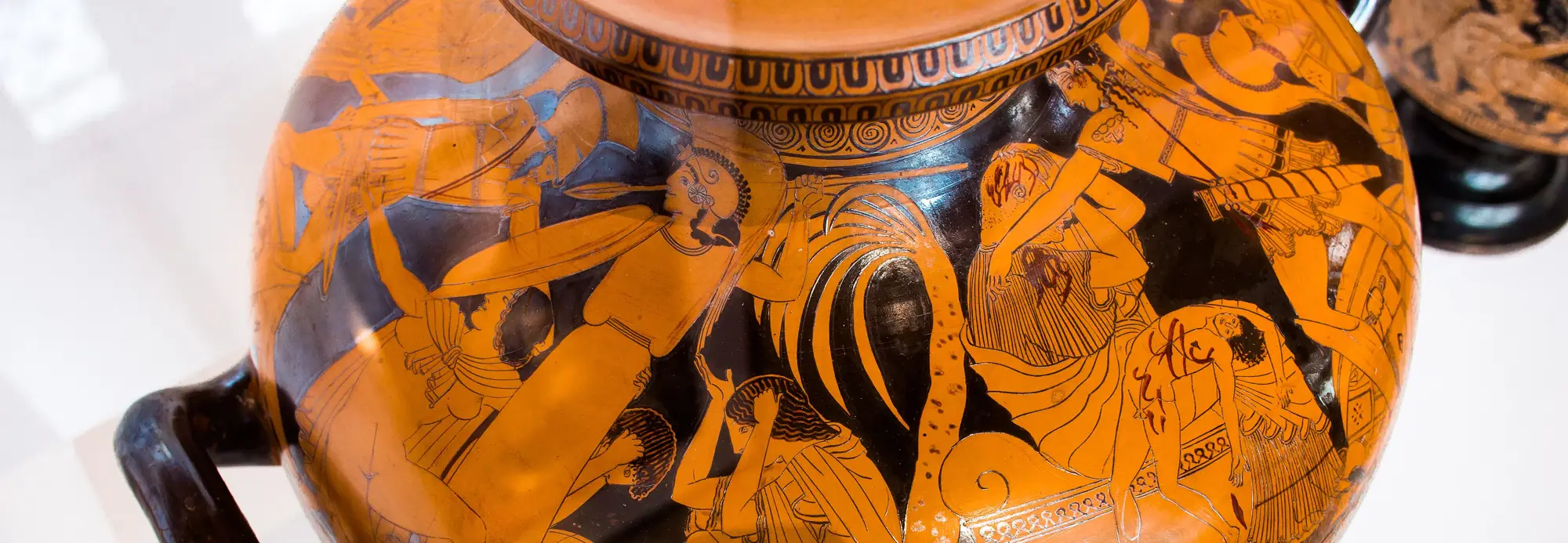
The Alexandra is a single speech of 1,474 lines, spoken by one man and reporting the words of a woman nobody in the poem believes. A guard set to watch Cassandra, Priam’s daughter, tells the king what she cried out on the day Paris sailed for Sparta — and what she cried out turns out to be nothing less than the whole future, from the fall of the city she can see coming to the rise of Rome, centuries after.
Her prophecy runs from the fall of Troy through the wretched homecomings of the Greeks who destroyed it, the scattering of Greeks and Trojans alike across the Mediterranean, the rise of Aeneas’ descendants in Italy, and the age-long feud of Europe and Asia that follows. Then, because Apollo’s curse on her requires it, no one believes a word.
Alexandra is Cassandra’s name in cult: she was worshipped under it at Amyclae in Laconia, and the poem has her foretell that very worship (1126–40). Almost no one else in the poem is named outright. Gods go by obscure local titles, heroes by animals — Achilles is an eagle, Hector a bull — places by allusions to half-forgotten stories. The vocabulary is crowded with rare words: on the Library’s count so far, close to two hundred occur nowhere else in surviving Greek. The Byzantine lexicon called the Suda already describes it as “the obscure poem”, and it reached us wrapped in commentary, the ancient scholia and the twelfth-century notes of the brothers Isaac and John Tzetzes filling the margins of almost every manuscript.
The shape of the poem
Eight turns, one unbroken speech. Each line range opens the text at that point.
1–30
The guard
A guard set to watch Cassandra begins his report to Priam: everything that follows is what she cried out, as he heard it.
Read lines 1–30 →31–364
Troy
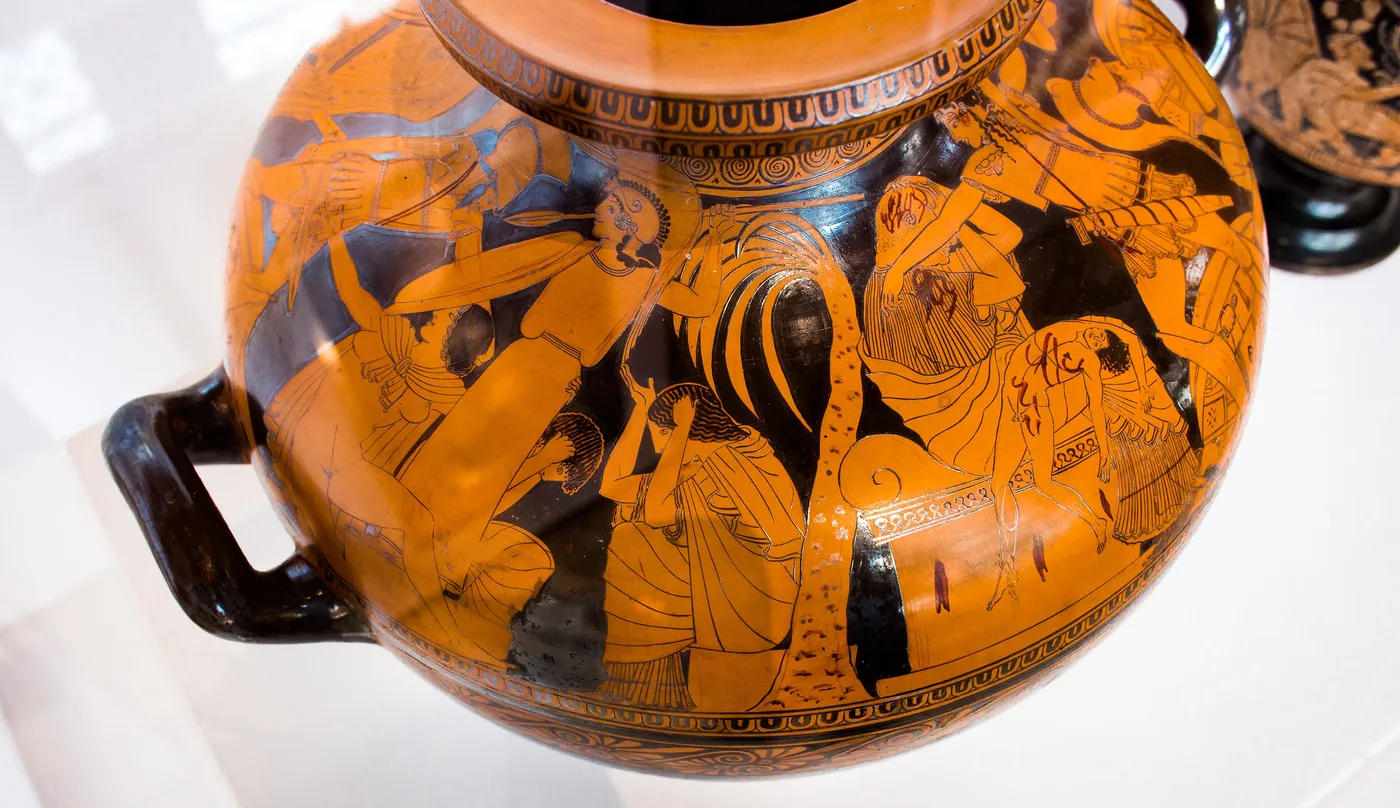
The burnings of Troy, Paris and Helen, the ten years of war, the lament for Hector, and Cassandra’s own fate at the hands of Ajax, dragged from the altar of Athena.
365–1089
The returns
All Greece mourns its dead. The fleet breaks apart: the ten-year wandering of Odysseus, the long exile of Menelaus, and the scattering of the survivors to Cyprus, Libya, Italy and Sicily.
Read lines 365–1089 →1090–1225
Homecomings
Agamemnon is murdered in his bath, Cassandra beside him. Her cult after death; the grief of Hecuba; the memory of Hector.
Read lines 1090–1225 →1226–1280
Aeneas and Rome
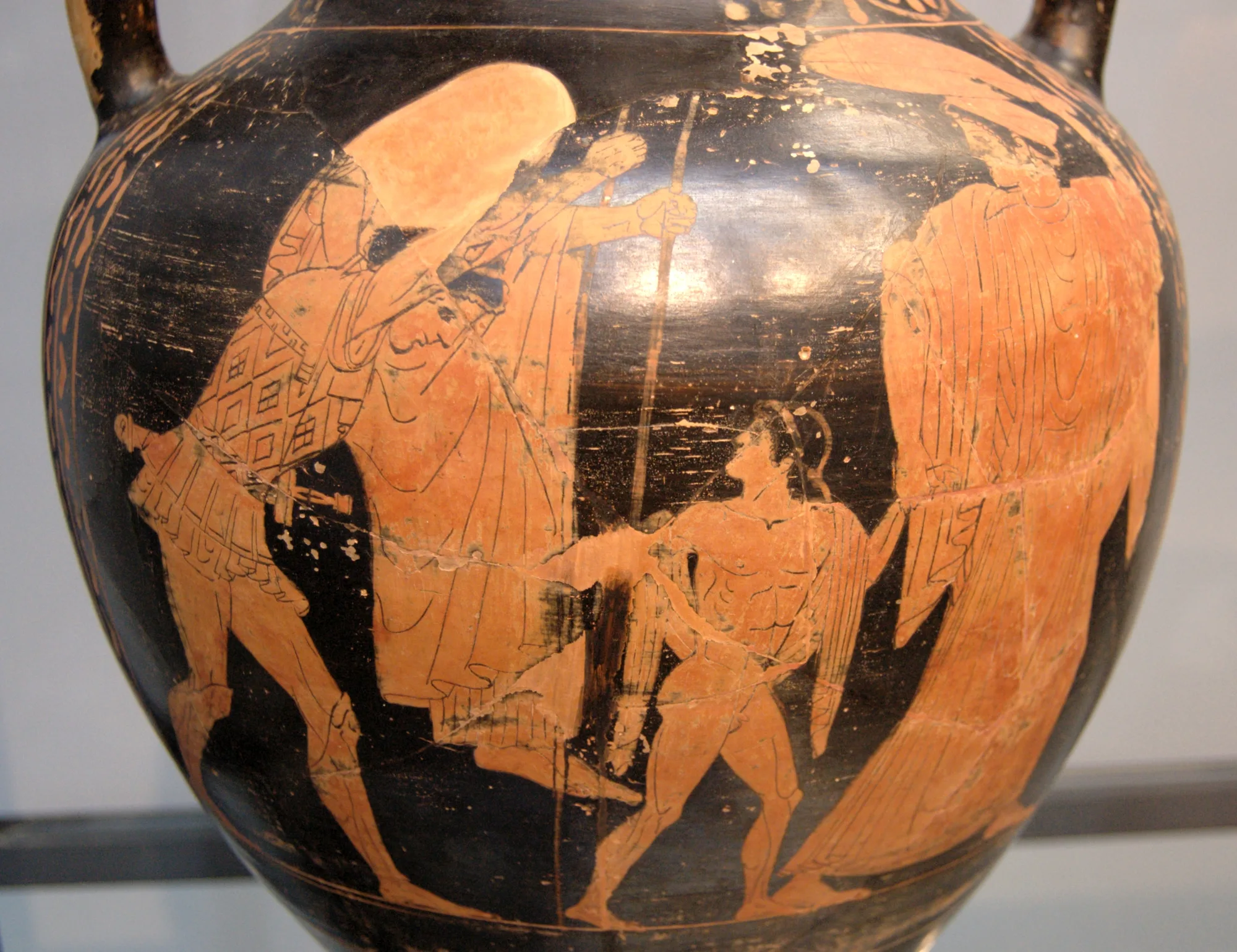
Troy rises again in Italy. Aeneas carries his father Anchises from the burning city, and his descendants found the power that will one day rule the Greek world in turn.
1281–1450
Europe and Asia
The long feud of the two continents, run back from the first mythical abductions of women to Xerxes’ invasion of Greece, Alexander’s conquest of Asia, and a final reconciliation.
Read lines 1281–1450 →1451–1460
Unheeded
Why, she asks, does she bark her warnings at deaf rocks and the black sea? Apollo’s curse holds: no one will believe her until it is too late.
Read lines 1451–1460 →1461–1474
The guard again
Cassandra is led back to her prison. The guard ends his long report where he began it, with a prayer for the king.
Read lines 1461–1474 →What the Library does
The Greek stands in the middle of the page. Everything readers have always needed to get through it sits in the margin, a click away, and every note says who said it, where, and where the idea began.
- any word
Its parsing and the full entry in Liddell–Scott–Jones. Lycophron’s own coinages and words found only here are marked as such.
- any line
Mair’s translation (Mooney’s and the Library’s own on the toggle), the commentary on what the riddle hides and who first solved it, the scansion, and the readings of the editions.
- an allusion
The passage echoed (Homer, Aeschylus, Euripides, Callimachus and others), opened in its own context.
- a name or place
Persons, gods and places identified through MANTO, Wikidata, Pleiades and ToposText, with public-domain and Creative Commons images, and the cult titles traced in the Mapping Ancient Polytheisms database.
- the scholia
The ancient scholia and Tzetzes beside the line they explain, in Scheer’s edition, with the differences of earlier editions noted under each one.
- the manuscripts
The witnesses from the Marcianus onward, with the folio of each line where it has been matched on the page images.
- the scholarship
A timeline of interpretation for each line, and a history from the Byzantine commentators to the present.
Where things stand
- Text. Mair’s Loeb text of 1921, checked against the printed page wherever the digital text went wrong. Every place where the Library departs from Mair is marked in the text.
- Commentary. A first note on every line, each with its attribution, now being checked against the sources.
- Scholia. Scheer’s edition checked by eye against the scans for the whole poem; Kinkel’s and Müller’s differences shown beneath it.
- Editions. Readings of Bachmann, Kinkel, Scheer, Holzinger and Mooney, each checked on the page image.
- Manuscripts. Line-by-folio concordances for the manuscripts with open images, the rest linked to their libraries.
- Translation. Mair’s by default; the Library’s own is a draft under revision.
Public-domain sources are quoted in full; commentaries still in copyright are cited for their ideas and never reproduced. Cite a line as lycophron.org/read/#l31. About the Library.